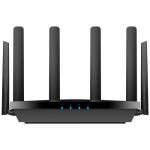
AX3000 Dual Band Ceiling Mount Wi-Fi 6 Access Point, Chipset MT7981, 802.11ax/ac/a/b/g/n, 2402Mbps at 5GHz + 574Mbps at 2.4GHz, 1 x 2.5G RJ45 Port, MU-MIMO, Support 12V DC or 802.3at PoE or Passive PoE, Internal Antennas, 12V DC adapter included, Cudy Mesh Support
Der Cudy AP3000 ist ein drahtloser Zugangspunkt, der für Hochleistungsnetzwerke in Innenräumen konzipiert ist. Mit Unterstützung für Wi-Fi 6 verbessert dieses Gerät die Konnektivität mit Datenübertragungsraten von bis zu 3 Gbps über mehrere verbundene Geräte und kann bis zu 512 Geräte gleichzeitig aufnehmen. Sein robustes Design ermöglicht eine flexible Wand- oder Deckenmontage und eignet sich somit für verschiedene Installationsszenarien. Ergänzt durch eine Dual-Core-CPU und 256 MB Flash-Speicher gewährlei
Hauptmerkmale rn rn Merkmale rn 2,4 GHz Ja rn 5 GHz Ja rn 6 GHz Nein rn Maximale Datenübertragungsrate 2976 Mbit/s rn Maximale Datenübertragungsrate (2,4 GHz) 574 Mbit/s rn Maximale Datenübertragungsrate (5 GHz) 2402 Mbit/s rn Ethernet LAN Datentransferraten 100,1000,2500 Mbit/s rn Netzstandard IEEE 802.11a, IEEE 802.11ac, IEEE 802.11ax, IEEE 802.11b, IEEE 802.11g, IEEE 802.11n, IEEE 802.3at rn Kanalabstand 160 MHz rn MIMO Ja rn MIMO-Typ Multi User MIMO rn Spread-Spectrum Methode OFDMA rn WLAN-Multimedia (WMM)/(WME) Ja rn Schnelles Roaming Ja rn Ratenbeschränkung Ja rn Betriebsmodi Wireless Access Point, Wireless Router, Wireless Extender, WISP rn Bandsteuerung Ja rn Airtime Fairness (ATF) Ja rn Quality of Service (QoS) Support Ja rn BeamForming Ja rn rn Sicherheit rn Unterstützte Sicherheitsalgorithmen WPA-PSK, WPA2-PSK, WPA3-SAE rn Funktionen Service Set Identifier (SSID) Multiple SSIDs rn rn Anschlüsse und Schnittstellen rn Anzahl
The Cudy AP3000 is a powerful dual-band Wi-Fi 6 access point designed to deliver fast, stable and secure wireless connectivity in modern home, office and small business environments. With a combined wireless speed class of up to 3000 Mbps (2.4 GHz + 5 GHz, depending on the exact configuration and environment), the AP3000 is engineered for dense client scenarios such as open-plan offices, coworking spaces, educational institutions, hospitality venues or demanding home networks with many connected devices.
Based on Wi-Fi 6 (IEEE 802.11ax), the AP3000 supports key technologies like OFDMA and MU-MIMO (where implemented in the device), which are designed to increase efficiency when many clients are active at the same time. This helps reduce congestion, improve latency and deliver a more consistent user experience, especially for video conferencing, cloud applications, 4K streaming and online collaboration tools. Beamforming support (when available in the model) further optimizes signal direction towards connected clients, improving coverage and throughput within the supported area.
The AP3000 is suitable for mounting in offices, corridors, meeting rooms or public areas and can be part of a larger network infrastructure with multiple access points for seamless coverage. Typical applications include providing secure Wi-Fi access for employees and guests, extending wireless coverage into previously weak spots, and enabling modern mobile workflows where laptops, tablets, smartphones, printers and IoT devices need reliable connectivity. Depending on network design, the device can be integrated into existing router and switch structures and used either as a central access point or as part of a distributed access environment.
Security is a key focus for business-class Wi-Fi. The AP3000 supports modern encryption standards (such as WPA2/WPA3 if implemented in the particular model) to help protect wireless communications against unauthorized access. Network administrators can typically segment traffic using multiple SSIDs and VLANs (where supported), allowing for separate networks for staff, guests and specialized devices. This segmentation contributes to better security, clearer policies and easier management of bandwidth and access rights.
From a management perspective, the AP3000 is designed to be straightforward to deploy and administer within the Cudy ecosystem. Many Cudy devices support centralized or app-based management, allowing network operators to monitor connected clients, adjust configuration parameters, update firmware and optimize performance without complex procedures. This reduces operational overhead and makes it easier for small IT teams or even technically savvy end users to maintain a reliable network.
Cudy is a networking equipment manufacturer focused on practical, good-value solutions for home and SMB environments. The company's portfolio typically includes routers, access points, range extenders, switches and related components aimed at delivering stable performance at an affordable price point. Cudy places emphasis on ease of use, clear configuration interfaces and solid baseline security features to ensure that both private and professional users can deploy dependable networks without extensive specialist knowledge.
With regard to sustainability and environmental protection, many networking manufacturers, including Cudy, increasingly pay attention to energy-efficient hardware designs and long product lifecycles through ongoing firmware updates. Efficient components can help reduce power consumption in continuous 24/7 operation, which is common for access points in business or hospitality scenarios. While concrete certifications or specific sustainability programs for the AP3000 are not publicly documented, opting for a modern Wi-Fi 6 device can itself be a step towards more efficient use of bandwidth and energy per transmitted data volume compared to older Wi-Fi generations. By investing in current, durable network technology instead of frequent replacements of outdated hardware, customers contribute to conserving resources and reducing electronic waste over time.
Choosing the Cudy AP3000 therefore not only improves network performance and user satisfaction, but also supports a more future-proof, efficient IT infrastructure. A well-planned deployment of high-performance access points helps reduce the total number of devices required for adequate coverage and can thus indirectly contribute to lower material consumption and energy needs in the long term. In this way, buyers align reliable connectivity with a more responsible use of technology.


 Network
19.029
- NAS/Storage 248- Power over Ethernet 71- Powerline 63- Repeater/Extender 165- Router/Switches 2.931- Video Surveillance 1.953- WLan 800- more Network 12.798Scanner 590Servers&Accessories 7.032Tablets 1.829
Network
19.029
- NAS/Storage 248- Power over Ethernet 71- Powerline 63- Repeater/Extender 165- Router/Switches 2.931- Video Surveillance 1.953- WLan 800- more Network 12.798Scanner 590Servers&Accessories 7.032Tablets 1.829