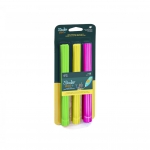
FlashForge HS PLA 1, 75mm FIRE ENGINE RED 201C 1kg (90010001001) Flashforge
35,99 EUR
plus shipping and customs
Hardware/ Electronic Flashforge
Shipping charges are minimized.
110 visitors are looking at this item
Delivery to US in:
5-9 workdays (only 8 left in stock)
Sales Rank:
#5 in more Printers #613 in Computer
Style:
more Printers
Product No.:
2101189644
Description:
FlashForge HS PLA 1.75mm FIRE ENGINE RED 201C 1kg (90010001001) is a high-quality PLA filament designed for reliable, everyday 3D printing with an intense, classic fire-engine red color. With a filament diameter of 1.75 mm and a spool weight of 1 kg, it is compatible with most FDM/FFF 3D printers that use 1.75 mm material and support PLA.
Technically, PLA (polylactic acid) is a thermoplastic biopolymer typically derived from renewable raw materials such as corn starch or sugarcane. HS PLA from Flashforge is optimized for stable extrusion, good layer adhesion, and precise dimensional accuracy. The recommended nozzle temperature range is typical for PLA; users should follow their printer's general PLA settings and fine-tune based on their machine and print environment. HS PLA is generally low-warping, easy to print, and suitable for both open-frame and enclosed printers that are compatible with PLA. Thanks to its 1.75 mm format and consistent filament diameter, it supports clean feeding and helps reduce the risk of jams and under-extrusion.
The FIRE ENGINE RED color is a bright, saturated red that stands out clearly, making it particularly suitable for parts where visibility and signal effect are important. This includes indicators, decorative elements, prototypes for consumer products, housings with signal function, or educational models where color coding plays a role. The opaque, vivid red ensures that contours are clearly visible and gives prints a professional and eye-catching appearance.
In terms of applications, FlashForge HS PLA 1.75mm FIRE ENGINE RED is well suited for: - Functional prototypes and design models where visual impact is crucial - Decorative objects, art projects, cosplay parts, and display pieces - Educational models in schools, universities, and maker spaces - Visual test prints and iteration parts in product development - Everyday utility items where high mechanical loads or high temperatures are not critical
PLA is not intended for use in high-temperature or heavy-duty mechanical environments, but it is ideal for visual and moderately stressed components. The material's ease of printing makes it a strong choice for beginners and professionals alike, reducing setup time and failed prints.
The advantages of this product include: - Easy printability with broad printer compatibility (1.75 mm PLA) - Low warping and good bed adhesion with typical PLA print surfaces - Stable color reproduction in an intense, signal-red tone - Fine surface details and good layer bonding when correctly calibrated - Reduced odor during printing compared to many technical plastics
Flashforge, the manufacturer, is an established brand in the 3D printing industry and is known for producing desktop 3D printers, filaments, and accessories aimed at both beginners and professional users. The company focuses on user-friendly, integrated ecosystems where hardware and materials are coordinated to deliver consistent print results. Flashforge has built a reputation for reliable products and continuous product development in the desktop 3D printing segment.
PLA, as a material class, is generally considered more environmentally friendly than many fossil-based plastics because it is usually made from renewable resources and is industrially compostable under specific conditions. By choosing an HS PLA like this, users typically benefit from a material with a lower environmental impact compared to many conventional petroleum-based filaments, provided the PLA is produced from such renewable sources. While specific sustainability measures of this particular filament are not listed here, PLA's biobased nature can help reduce reliance on finite fossil resources.
By purchasing and using a PLA filament of this type instead of classic, purely fossil-based plastics, customers can often make a small but meaningful contribution to more resource-conscious 3D printing, especially in combination with thoughtful use of material, long-lasting designs, and responsible disposal in accordance with local regulations. The durable red parts that result can help avoid frequent reprints and waste, contributing further to more efficient material use.


 Printers&Accessories
19.322
- Fax Machines 4- Ink&Toner 10.672- Inkjet Printers 22- Label Printers 643- Laser Printers 266- Multifunction print. 303- Photo Printers 24- Printer & Copy Paper 1.796- Printer Accessories 4.164- more Printers 1.428Scanner 590Servers&Accessories 7.032Tablets 1.829
Printers&Accessories
19.322
- Fax Machines 4- Ink&Toner 10.672- Inkjet Printers 22- Label Printers 643- Laser Printers 266- Multifunction print. 303- Photo Printers 24- Printer & Copy Paper 1.796- Printer Accessories 4.164- more Printers 1.428Scanner 590Servers&Accessories 7.032Tablets 1.829